🧑🔎 Organizations Must Prepare Employees for Generative AI Disruption: New Research From HR Firm McLean & Company
Friday, 22 December 2023 10:21.AM
- As organizations continue to navigate the future of work, global HR research and advisory firm McLean & Company suggests that preparing workforces for disruption from generative artificial intelligence (AI) will require evolving strategic HR initiatives to better address the talent gap driven by emerging technologies. -
Generative artificial intelligence (AI) continues to influence the way work gets done by assisting with and substituting tasks. However, alongside the ample benefits come complications, such as disrupting existing roles, shifting skill requirements, and affecting workforce composition, according to the latest research from McLean & Company, a global HR research and advisory firm. The newly published industry resource, Address the Talent Gap Driven by Generative AI, provides insights that will help HR leaders understand the workforce planning implications of generative AI and adjust initiatives to fill the talent gap.
"Generative AI has the potential to disrupt organizations by automating tasks, reshaping roles, and shifting talent requirements," says Lisa Highfield, principal director of Human Resources Technology & Artificial Intelligence at McLean & Company. "The success of organizations in leveraging generative AI to drive organizational objectives hinges on HR to address the underlying impacts on talent."
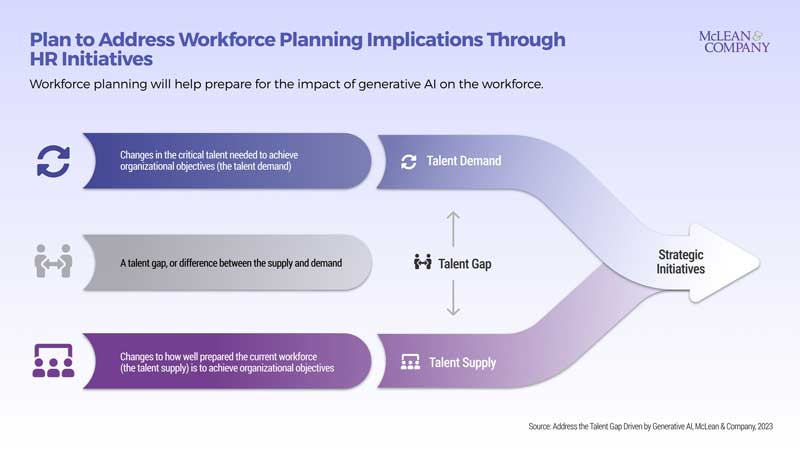
Organizations that adopt generative AI are more likely to gain a competitive advantage through increased productivity and performance, the firm's resource explains. To successfully leverage new technologies, McLean & Company highlights in the blueprint that organizations must first determine how generative AI use supports the organization's strategic objectives to discover its impact on the workforce, and in turn, the talent demand, supply, and gap.
"HR can address the talent gap driven by generative AI by adjusting and developing strategic HR initiatives to build, buy, borrow, redeploy, or reduce talent," explains Highfield.
To support HR leaders in the future of work, which continues to be heavily impacted by generative AI developments, McLean & Company offers research insights on how to navigate the impact of AI on talent, split into two key sections in the blueprint. An overview of the research is outlined below:
1. Section One: Understand workforce planning implications.
The first section discusses the anticipated influence of generative AI on roles, tasks, skills, and workforce demographics. For example, roles requiring a higher degree of decision-making and problem solving, organizational knowledge, creativity and innovation, and social and emotional intelligence are less likely to be automated.
The guidance and insights in section one can also help HR leaders understand the impact of generative AI on roles, how it will change the demand for technical and non-technical skills, and how generative AI may contribute to the digital divide and disproportionately affect certain populations.
2. Section Two: Address talent gaps.
The second section identifies actions HR can take to reduce talent gaps driven by generative AI and ensure the organization has the right talent in place to meet objectives. Examples of these actions include understanding when to build, buy, borrow, redeploy, or reduce talent in order to respond to organizational needs appropriately, and determining the next steps needed to address talent gaps.
Additionally, section two will support HR leaders in planning to address generative AI's impact on workforce planning initiatives and adjusting HR initiatives to plan for the talent gap driven by the new technologies.
McLean & Company suggests that while workforce planning will help prepare for the impact of generative AI on the workforce, discussions around talent demand, supply, and gaps will help navigate generative AI disruption even without a formal workforce planning process.
To access the full research and insights, please visit Address the Talent Gap Driven by Generative AI.
SOURCE: McLean & Company
-
Related materials:
- 05-Jun-2026 04:09 PM 🧑🔎 New Research From CCRW Shows Businesses Need to Build Their Disability Confidence to Fill Talent Gaps
- 03-Jun-2026 10:17 AM 💵💻 IBM Commits More Than $10 Billion to Quantum Computing, Funding Its Roadmap from Today's Leading Systems to the World's First Fault-Tolerant Quantum Computers
- 01-Jun-2026 02:23 PM 🧑🔎 ECO Canada Opens Applications for 2026-2027 Student Work Placement Program
- 30-May-2026 12:00 PM 🖥️ ALL IN Talks Toronto Unites Ontario's AI and Tech Leaders to Strengthen Canada's Innovation Landscape
- 29-May-2026 06:33 PM 🏠 Un-Habitat and CMHC Launch Partnership to Advance Housing Solutions in Canada and Beyond
- 29-May-2026 12:00 PM 🖥️💵 Koodo Gives Customers a 5G Speed Upgrade at No Extra Cost
- 29-May-2026 10:27 AM 💵💻 Government of Canada and Government of the French Republic sign joint statement on quantum science and technologies cooperation
- 26-Mar-2026 10:28 AM 🧑🔎 B.C. Has Fourth-Highest Top Personal Income Tax Rate in Canada And U.S., Making it Unattractive for Top Talent
- 25-Mar-2026 02:33 PM 🥘🔪 Competition Bureau Calls to Take Down Regulatory Barriers Around Shared Kitchens and Food Hubs
- 24-Mar-2026 12:00 PM 💵🧑⚖️📝 Tax Tip - What You Need to Know About Protecting Yourself From Ai-Generated Tax Scams 💻📱